


Good old Charley Watkins
If like me, you grew up in the ‘60s-‘70s, listening to music and playing in bands, you will be no doubt be familiar with the electronic equipment name Watkins Electric Music. Charley set the stage (no pun intended), launching many musicians into stardom.
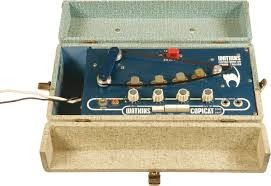
There were two main avenues to Charley’s legacy. one was the Public Address system and guitar amplifiers, the other was the famous ‘Copicat’, a tape reverb unit. I’ll talk about the Copicat here, and in a next article, bore you with his P.A. system designs.
Born in 1923 in South London, Charley grew up in Battersea. A bit of a tough childhood, he ended up joining the Merchant Navy, where he managed to survive many a trip during the Battle of the Atlantic. One of the lucky 25% that survived. During this time, he heard someone playing an accordion. He liked it so much he got himself one and played professionally around London.
In ’49, he went into business with his brother Reg. and had a shop in Balham High Road, selling records and guitars. Reg, a cabinet maker, designed and built a solid body guitar, called the Rapier. Charley on the other hand preferred working at the rear of the shop messing about making amplifiers. He built 20 units which were designed for use on AC or DC mains supply. DC was dangerous, but many areas still were supplied with this. It had a way of accidently killing guitarists, so Charley recalled them all for modification.
In ’58 Charley heard a song by Italian Marino Marini. He liked the vocal echo effect. To obtain this, it could only really be done in the recording studio with one or two large reel to reel tape recorders. He was aware that there was an Italian made echo machine which used a magnetic drum. It was expensive and unreliable. Charley had an idea of using a loop of tape to record audio on, which could repeat itself ad infinitum. Knowing his technical limitations, he employed an engineer, Bill Perkins. They worked on a machine which consisted of a loop of tape that could run at a variable speed. The audio was recorded by the first head the then picked up by one or more of the three remaining heads as the tape passed by a split second after. Various controls allowed you to mix the different signals together with varying levels, erase once heard, or continually allowed to re-record (sustain) giving a wonderful space age sound. Charley admitted that there were several electronic bad designs with the machine, allowing it to run into distortion. However, this sound became loved by its users and record producers. Now, for the first time bands and musicians could recreate the echo sound live on stage and in small set ups, which could have only been afforded to them in large expensive studios.
By ’62 W.E.M had built 100 units and put them on sale in the Battersea shop. These had a price tag of 38 quid plus tax. Within a day, all were sold and production struggled keeping up. The first machine sold to Johnny Kid of Johnny and the Pirates. So it goes, Shakin’ all over was the first UK hit to use the Copicat with its distinctive sound creation. It was a massive hit and small studios, like Joe Meaks’ above a handbag shop in Kensington. The machine was used here for recordings such as Telstar by the Tornados and so on.
At one point, production was running at 1000 units a month. These machines were valve based and apart from the echo facility, they could be used as a preamplifier for guitars. With the control settings in the “wrong” position, the distortion gave players an added depth to the sound they liked. This was due to one of the flawed design aspects earlier mentioned.
The later versions were similar, still using tape loops but were transistorised. Some purists said that the sound was never quite the same. However it did not stop over 100,000 being sold and the likes of Blackmore, Thin Lizzy, Artic Monkeys, Reggae artists all loving the sound it gave them.
As technology moved on, similar machines became available from Japan. Roland made some very fine variations with loops of tape many feet long, lasting longer. W.E M. saw this happening and faded out production.
I have repaired many of these machines and they all have a lovely “home-made” feel about them. I was lucky to meet Charley a few times. Like me, he was unassuming, short, bald and a miserable sod.
So next time you hear Shakin’ all over on the juke box, look upward and say thanks.
Now for the P.A. side.
Charlie realised that whilst instruments at that time had amplification, singers etc. struggled to be heard. Most sound enforcement systems were Tannoy type horns which were horrid to listen to. So he went about making a system aimed at a truthfully amplifying the human voice. He did this buy building speaker cabinets fitted with Goodman Axium 301 model drivers. These units were used in HiFi systems and sounded sweet.
Watkins supplied a trial system the Rock group, the Byrds. But it failed and lead to a bit of barney. Undeterred, Charlie redesigned the system, resulting in an amplifier which became a bench standard, the WEMSL 100. This was a 100 Watt slave amplifier, 10 of which would be linked together. It was a sort of copy of an American RCA product using Germanium transistors. These amps along with the large multi-speaker columns sounded great! From the mid ‘60s to the mid ‘70s, WEM was the go-to P.A. system. This put the little factory in Offley Road London SW6 on the map.
Watkins Also designed a portable mixing console. 5 channels, reverb, equalization and feeds to slave amplifiers and monitors. 2 could be linked together if needed. These also provided an output to a foldback loudspeaker, which allowed the performer to hear themselves. This invention was as a result of Jimmy Hendrix playing at a concert, unable to hear himself. Charlie turned around an audience facing speaker, pointing at Hendrix. Problem solved. The “Fold-back” was born.
Charlie wanted to muscle in on “big events”. He wanted to get his equipment at the isle Of Whight Windsor Blues Festival in ’67. The promoter told Watkins he could supply the PA, for free and take responsibility for it all. He did and it was a great success. Loads of speaker cabinets and his WEMSL100s giving 1000Watts. Which in those days was massive. It even resulted in Watkins being arrested for breach of the peace!
In ’69, the Rolling Stones played at their famous Hyde Park concert. Here Watkins supplied another massive system, totaling just under 2,000 Watts. It was a great success and further more boosted the manufacturing of hundreds more WEM systems. The Stones wrote a lovely letter to Charlie, thanking him for a great sound.
By the early ‘70s Watkins saw a change in the requirement for concerts. More volume was always required. Charlie’s method of just adding amplifiers and more cabinets was flawed. As the Sound-man for the group The Who said, another 1,000 Watts gives you only 2 decibels extra. Keep adding equipment means more transport costs, more supporting staff, more weight. Watkins also had a moral issue with the amount of volume being generated which could damage hearing. He actually paid for a Harley Street consultant for advice on this. His fears were confirmed. He also disliked the change taking place at concerts. What used to be cool friendly events, were now taking on a violent aspect.
There was a new loudspeaker technology coming on to the market. P.A. companies were using folded Horn designs. This type of speaker cabinet allowed the sound energy to be far more directional, aiming at the audience. Watkins Column speakers were great for audio quality, but radiated audio over a wide area, wasting energy and consuming a large foot print. The Loaded Horn speakers were able to provide the same audio coverage at a fraction of the power required. Staff and transport costs were therefore reduced. In addition, there was a move away from bands owning their own equipment and sound guys. Hire companies were becoming common place, proving staff, equipment when and as required. Charlie saw this happening and could not and didn’t want to compete. By ’74, things were winding down and the output from the factory in SW6 was a shadow of what it had been.
The legacy however lives on. WEM equipment on the second-hand market holds high values. The little WEM dominator guitar amplifiers can fetch up to 1,000 quid or more. Noel Gallagher loves his and used it on his studio recordings. The original WEM Copicat reverb units are equally prized.
So, there we have it. A diminutive unassuming chap in South London, loved by the Rock Stars, left his stamp on history with his ideas of quality sound reinforcement and the Copicat Echo machine. It was nice chatting with you in the early ‘80s. Meet again one day.
Seth. Zeta services. Working hard for you.
Seth, Zeta services. Working hard for you.